Feeds:
Posts
Comments

Posts Tagged ‘outdoors’

I put in mid-morning, three days after Christmas, under overcast skies in chilly (brrrrr…60 degrees!), breezy weather. Winter had arrived in Florida!  My location, the Chassahowitzka River Campground—probably the best, if not the only put-in on the “Chaz.”
Paddling Over One of Seven Sisters

It took me some time just to be able to pronounce the name of this river—Chassahowitzka—and I’m still not certain I have it right. The Chaz is an Outstanding Florida Waterway. The river is wide, wide enough for boats, but shallow in many areas, keeping bigger boats away. It’s about six miles from the river’s source, just east of my put-in, to the Gulf. (See map.)

I had delayed my paddle on the Chassahowitzka expecting little shade from the hot sun during the summer months. However, I learned that what makes this waterway so special are the many spring runs along it—which are narrow and shaded and full of sweet surprises.

Jesse put me in at 10:30 a.m., securing my snake knife and cooler. (Others had told me there were many snakes on the river. However, I did not see one.) I paddled away, the water below me clear, heading just east to the Seven Sisters Spring. I passed a few small houses at the entrance to the spring and paddled into the little cove and over each of the seven sisters, all easy to see just below the clear surface.

Exiting the springs, I paddled west along the wider river, spying schools of fish scurrying about below me. I later discovered that they were most likely mullet or mangrove snapper. Cypress, oaks, palms, and river grasses stood tall along the banks, bending slightly with the breeze. I saw tents pitched along the north side, smelling the campfires even before I saw the campers.

Jesse had described two “must see” areas that would provide me a peak at nature along the river, and that’s where I headed, eventually paddling into a narrower loop to the right toward Salt Creek. I spent an hour or so here, paddling up each of four narrow waterways, feeling rewarded when I spotted a raccoon couple making its way to the water, searching for a late breakfast. Birds huddled along the shallow banks and on branches—anhingas, small herons, egrets, and ibis. Wood ducks paddled along the water’s edge.
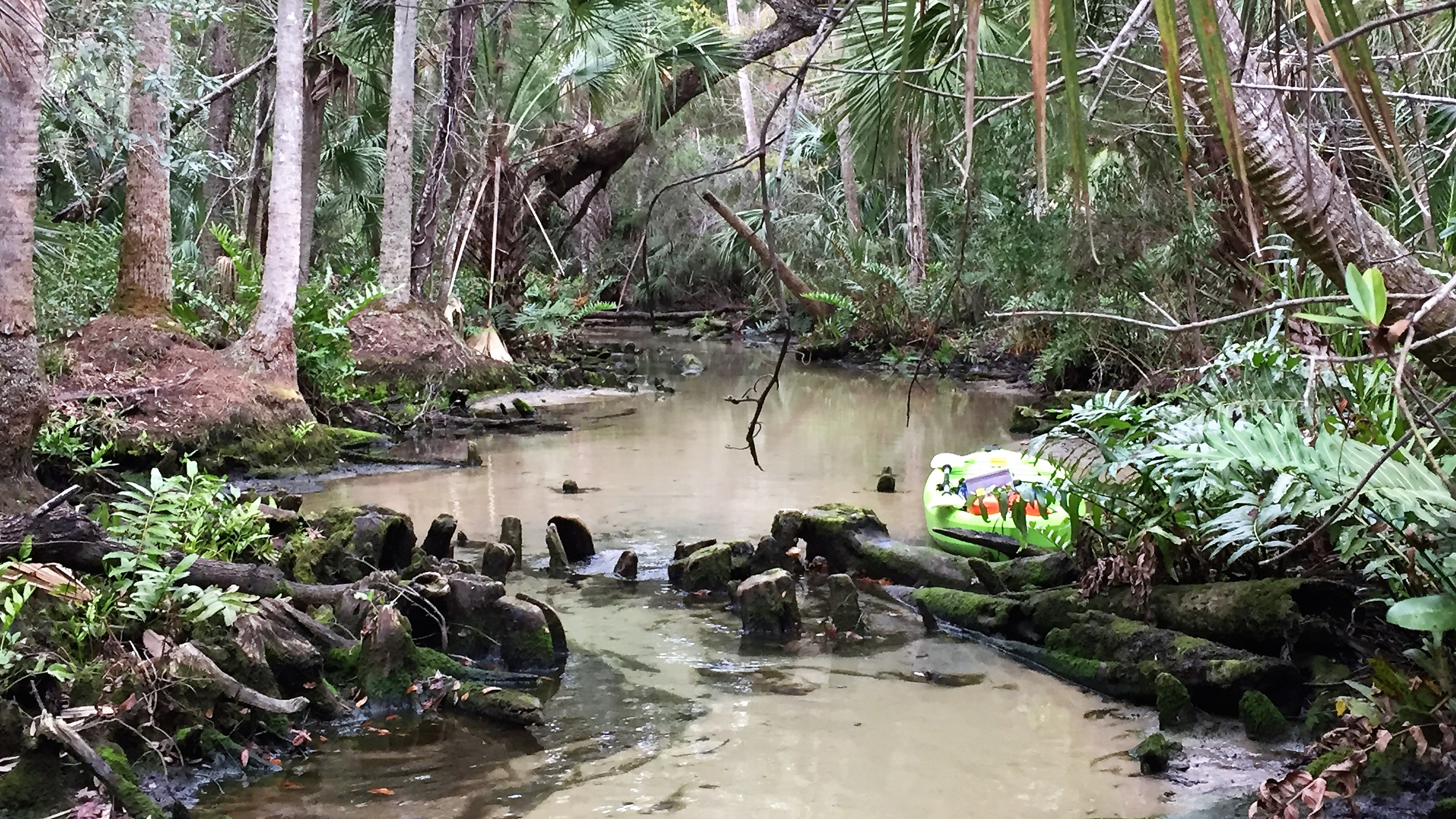
Forced to Portage on Baird Creek

Time went by quickly on the waterway—over two hours had already passed. I felt the refreshing cold on my face, the kind that turns your nose and cheeks red. I headed back towards the outfitter and up another spring run on the south side of the river, Baird Creek. I came upon a wood stork on the side of the narrow creek, searching for food, not bothered by my presence at all. I paused as I watched a playful otter dipping in and out of the water around the stork and my kayak. No fear. I carefully paddled around them, and continued until the waterway widened over Blue Spring. A bit further, and I was once more in a narrow, shallow waterway and was forced to get out and portage until a downed tree finally stopped me. From here, I sloshed about 150 feet through ankle deep water until I arrived at a clear pool of aqua water and the Crack.

In all, I was in the river four hours and never got far from my put in. On my return to the outfitter, I was treated to three colorful mallard ducks dipping in the water. A light rain began just as my trip ended.

(Chassahowitzka River Campground. 8600 W. Miss Maggie Drive, Homosassa, FL 34448. (352) 382-2200)
Read Full Post »

Originally from New England, I find that Florida often surprises me with its knack of squeezing beautiful glimpses of nature in among the hub of civilization. Shingle Creek is one of these surprising glimpses.

Entering Shingle Creek

I took exit 242 off the turnpike and drove west through the Kissimmee sprawl on US 192 for several miles. Finally, my phone nagged me that Shingle Creek was just ahead on my left. “You’re kidding me, right?” I responded, not believing. I must have entered the address wrong. However, I made a U-turn at the light and took a right as directed, driving down a short, cypress-lined driveway to the outfitter and put in.

Considered the “headwaters of the Everglades,” Shingle Creek originates around Orlando and travels about 23 miles before it empties into Lake Tohopekaliga, (Ten of the 23 miles are part of the Florida’s Designated Paddling Trail system.) The creek makes up a portion of the Kissimmee basin—the waters that eventually flow into Lake Kissimmee and then the Kissimmee River. The Kissimmee River drains into Lake Okeechobee which flows into the Everglades and the Gulf. (Shingle Creek Regional Park)

I rented a kayak from The Paddling Center at Shingle Creek and pushed away from the shore on the small, still creek, heading south towards the lake. At the point of my put-in at Steffee Landing, I would only be able to navigate two to three miles of the creek (north and south of my put-in), a three-hour paddle at the most.

I paddled the creek, dead leaves fallen from overhanging trees floating on top the cool water. Although sounds of traffic and the local Kissimmee airport seemed to compete with the calming, rhythmic sounds of nature on the waterway, the wildlife appeared undisturbed.  Birds sang from the trees and waded along the banks. Turtles sunned themselves on downed trees. I put my head back looking up to the clear sky, breathed in deeply, and decided to ignore civilization as well. I focused on my surroundings—the dark water below me and the cypress, pine, and oaks along the creek’s banks.

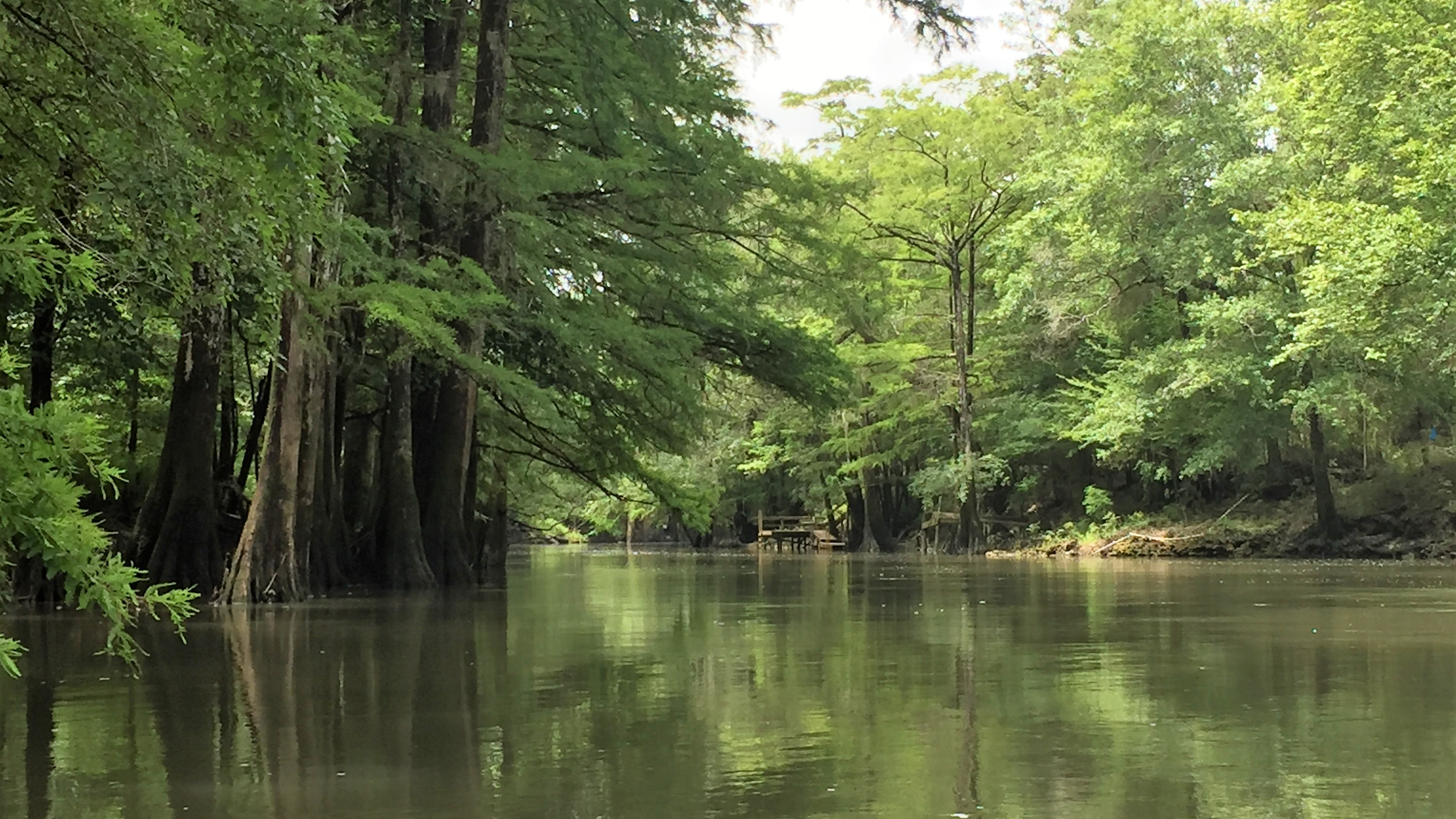
Paddling Among the Cypress

Hurricane Irma had left the waterway a bit haggard here and there with downed trees and dead brush, while the Florida winter had stripped the trees of much of their foliage. However, the creek was lovely. Ten minutes into my paddle, I passed the banks of the Shingle Creek Regional Park on my left. I continued my southern paddle as the creek narrowed, and soon I was paddling among the cypress trees. Ahhhh…

Nearing the end of the clear trail, a posted sign warned me to stop and turn around. I admit I ignored the sign and paddled another 15 minutes. The trail, now winding among the cypress trees narrowed further while the flow of the water picked up a bit.  Another sign warned me that it was unsafe to continue—perhaps due to downed trees in the path. I paddled just a wee bit further before turning around, seeing the path blocked ahead.

On my return paddle going north, I passed the outfitter and under the US 192 bridge. The creek widened here but was still bordered by tall cypress. A shorter paddle this time, I eventually came to another outfitter sign instructing me to go no further. I continued until the creek became impassable—just a short distance.

Shingle Creek turned out to be a pleasant surprise and the perfect getaway—a two-hour paddled stretched into three for me. I found beautiful pieces of nature in the least likely place. I left reluctantly, spying the walkways and bike trails through the woods as I loaded my car, wishing I had time to linger.

(The Paddling Center at Shingle Creek. 4266 W. Vine Street, Kissimmee, FL 34741 (407) 343-7740)

Read Full Post »

Spillway/Dam to Magnolia Bridge

Having spent the majority of a four-hour paddle in the rain the day before, I opted for a shorter paddle on Wednesday. Ricky drove me to the Spring Creek spillway on US 90, shoving me off (Woo-hoo!) about 10:00 a.m., just as the sun pushed through the clouds.

Clear Waters on Spring Creek

I paddled away on the clear, shallow waterway, the spillway and Mill Pond to my back. From this point, I had a two-mile paddle to Chipola River and then another two miles to the outfitter where I had left my car. (See page 2, map).

What a sweet paddle! If I lived close by, Spring Creek would be my “after work before it gets dark” paddle. This is how I would de-stress from a crazy day. (I never think about work while paddling.) Recent rains had pushed the water over the low banks of the creek and into the woods. However, it remained clear and low enough that the sandy, shell-covered bottom was within an arm’s reach. Fish scurried by below me while egrets waded in the shallows along the banks, searching for a tasty snack. The many fallen trees along this twisting, turning waterway created comfy spots for turtles to sun themselves. Birds sang cheerfully in the trees as I paddled by.

Back on the Chipola River

Less than an hour into my paddle, I saw the very distinct line where the clear waters of Spring Creek met the murky Chipola River. I had passed this point when I paddled the Chipola the day before. The sun still shone, and I was disappointed that the end of the creek had come so soon! I completed the entire trip—about four miles—in less than two hours.

(Outfitter: Bear Paw Canoe Rentals. 2100 Bear Paw Lane, Marianna, Florida 32448. (850) 482-4948)

Read Full Post »

I call “do-over” on this one. I was never quite sure where I was!

I had hoped to paddle the upper Ochlocknee, a more narrow and twisted river. Failing to find an outfitter who would drop me, I decided on the Ochlockonee River State Park located on the lower Ochlocknee for a put-in. I intended to paddle the short distance from the Park’s put-in to Bear Creek. (Bear Creek connects two parts of the Ocklockonee on a loop.) I would then emerge back onto the Ocklockonee with a short paddle back to the put-in—about a 7.5 mile total paddle according to the Park’s map.

The Put-in at Ochlockonee River State Park

The Ocklockonee River originates somewhere in the swamps of Georgia. Its scape changes as it travels southeast and sometimes southwest and eventually the waterway twists and turns and empties into the Ochlockonee Bay. At the point of my put in, the river creates a camel’s hump. Bear Creek crosses through the hump.

I put-in mid-morning, and although wide at this point, the river was quiet and peaceful and beautiful. I love being the only one on a river; there is nothing else as serene. I paddled south, southwest, the Park on my right–tall straight pines bidding me farewell from the shore. Birds called from the trees; blue herons waded by the water’s edge; and a swallow-tail kite flew overhead, a tasty breakfast in his talons.

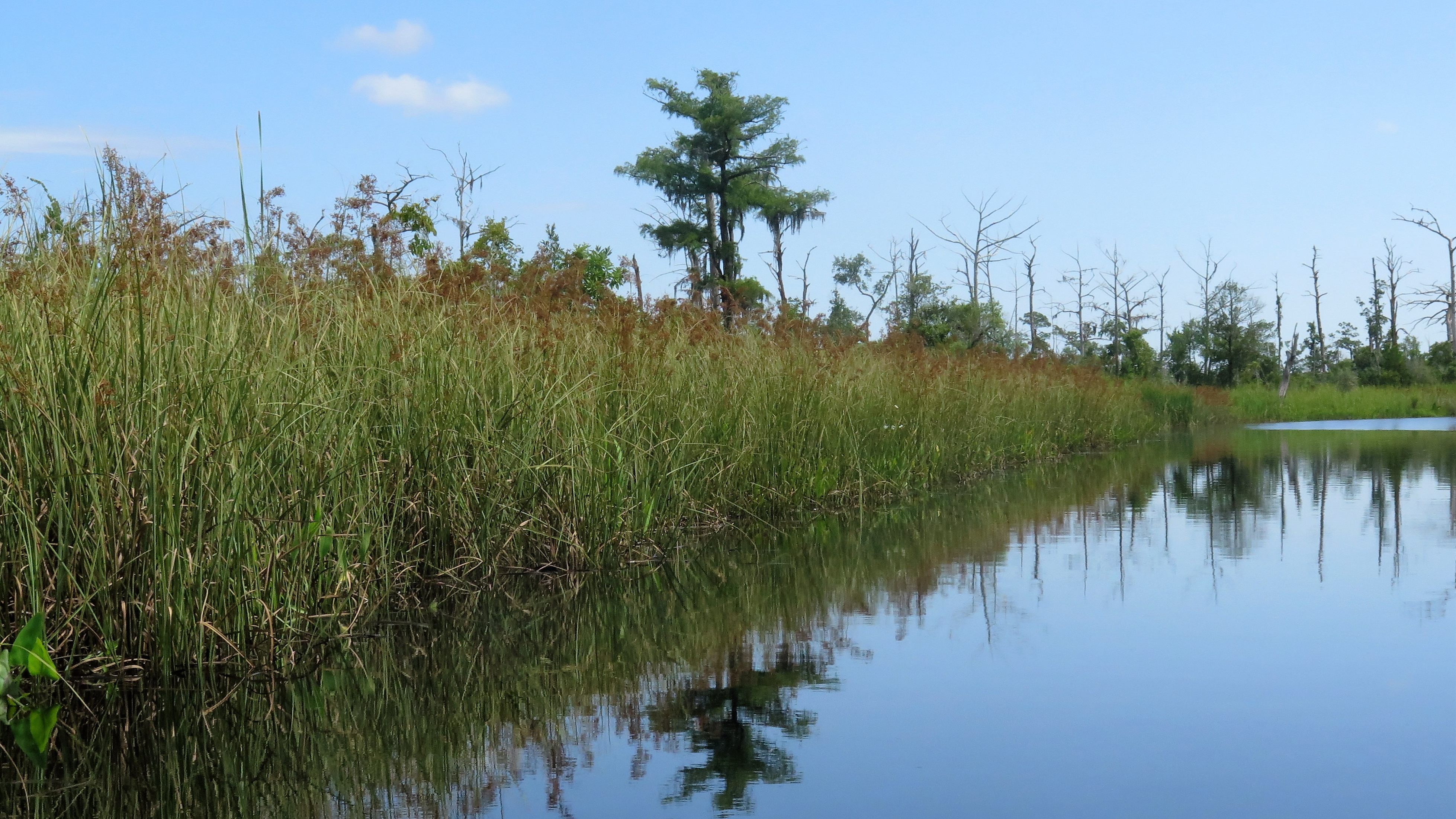
After about 20 minutes on the wide waterway, I entered Bear Creek on my left, immediately surrounded by tall swamp grasses. The creek was perhaps 50 to 70 feet wide with no shade, so I was grateful for the clouds overhead. Tall dead trees silhouetted the sky-many with either osprey or eagle nests on top. One tree had several eagles perched in and around the nest.

The sky darkened, and a slight, cool breeze caused me to think that it might rain. Alone on the dark waterway, I paddled, expecting my surroundings to change. Steven, the man at the Park’s guard gate (and coincidentally the son of an author of one my guide books) had told me that I would come to some shade and small cliffs. However, I continued to paddle through the tall swamp grasses.

Something I did not expect—at two points in the creek, I had to decide—go right or left? The first time, I went left. Ten minutes into my paddle as the tall grasses encroached to the point where I could touch them on both sides, I realized I had made the wrong choice. Whoops! Below me in the water I could see a lone fish, long and pointed with spots, his fin above water. He paddled beside me for a bit, but was no help at all.

Tall Swamp Grasses on Bear Creek

The second time, I turned left first, scouted it out for a bit, then doubled back and went right. This is where I believe I went wrong. However, I can’t tell for certain with the maps I have found. I may have somehow connected with the Cow Creek. I’m not sure, but after about an hour of paddling, I knew I was not on Bear Creek. I checked my location on my phone the best I could (before I dropped my glasses into the water, that is), and it appeared I was in a waterway to the right of where I should have been. I called the park folks, and to their credit, they did not hesitate to tell me that they would send someone out to find me. But I wasn’t going to give up yet. I paddled awhile longer and eventually came out…strangely, just south of where I went in—Cow Creek?

I had put in that morning at 10:45, expecting to return around 3:00. Here, I was back by 1:15. Sadly, I never saw Bear Creek Bluff, and I didn’t have the time to start over again. Thus, my need for a “do-over.”

The red trail on the park map shows my intended trail. The waterway to the south of where I entered Bear Creek (left) I believe is Cow Creek and where I came out.

For some great reading about the Ochlockonee River, try this site.

(Ochlockonee River State Park. 429 State Park Road, Sopchoppy, FL 32358. (850) 962-2771. Stephen Carter)

Read Full Post »

Hello, old friend. Happy New Year!

I paddled my first Florida river in July 2010 and have paddled over forty Florida rivers since. Unquestionably, Fisheating Creek holds a place in my top five. I love this waterway!

Entering the Cypress Swamp

As I have done in the past (because I have yet to buy my own kayak, and I need a drop anyway), I rented a kayak from the Fisheating Creek Outpost in Palmdale. (The people are great; the kayaks, a bit worn.) They dropped me, along with five others, around 10:00 a.m. at the Burnt Bridge put-in, giving us an eight-mile paddle back to the outpost—about four hours. I waited to put in last, standing on the shore and taking it all in. Fish jumped as if playing a tune on a xylophone, and then, seemingly on cue, an alligator glided slowly along the top of the water in the distance. It all appeared to be an opening number of a musical, a glimpse of something wonderful yet to come.

This would be my third paddle on Fisheating Creek. I paddled it in October 2011 and July 2014—both times with a much higher water level. The level on New Year’s Day was just over three feet. To paddle without portaging requires a minimum of one and a half feet. I would not want to portage on this creek with as many gators as I saw this day.

I paddled away from the shore, feeling somewhat secure that I had remembered to bring my snake knife this time! Tall cypress, turned brown and draped in moss shrouds and air plants, framed the waterway. Twenty minutes into my paddle, I entered the cypress swamp—my favorite part—and paddled among the cypress trees, twisting left, then right, the landscape deserving the front cover of a nature magazine. Paddling this creek for the third time, I have discovered that it’s pretty darn important to watch for the small kayak signs to stay on the trail. More than once I had to turn around and find the trail again.

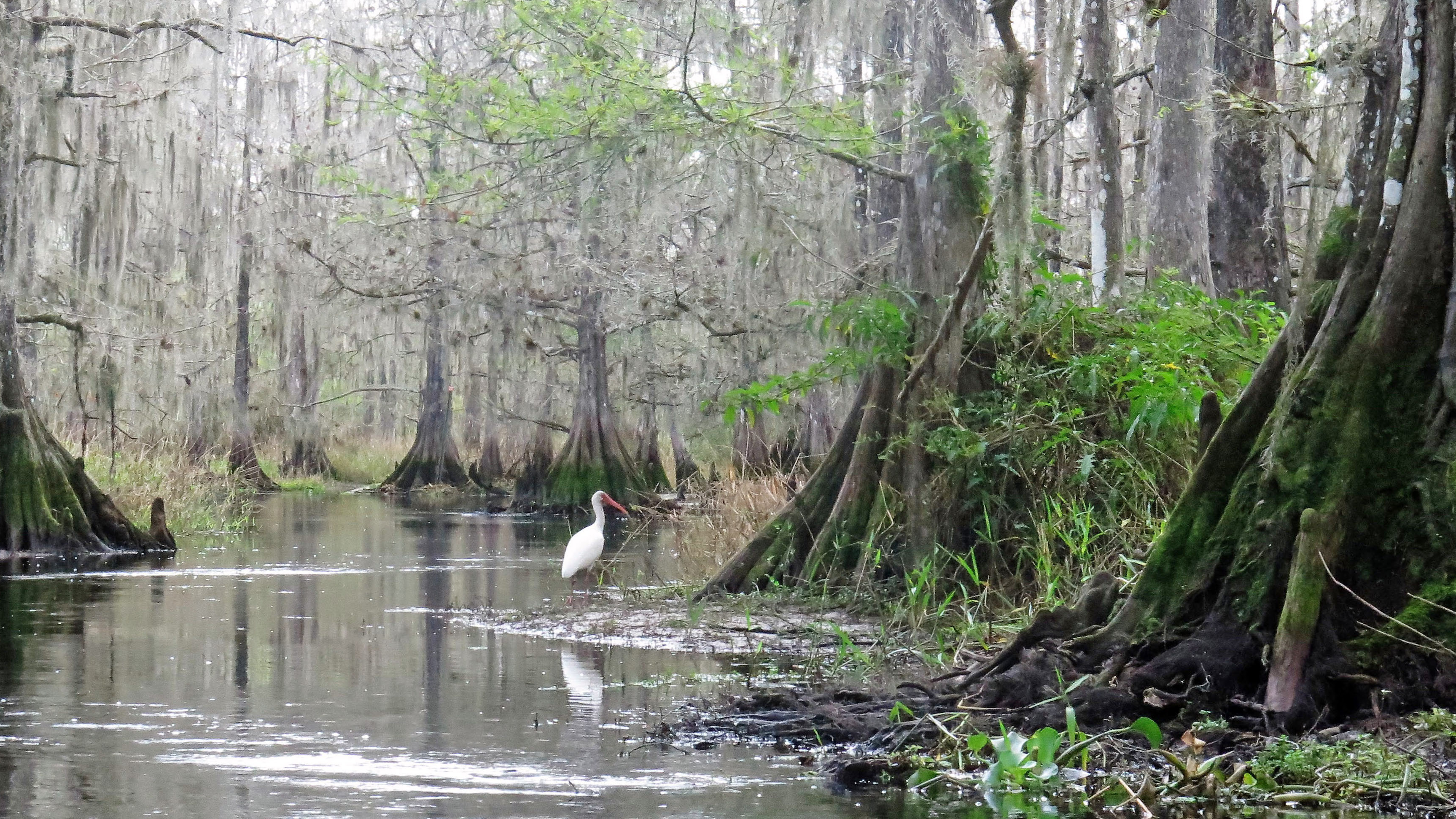
White Ibis on Fisheating Creek

The other paddlers had gone ahead, so I was alone in the swamp, enjoying the sweet melody of bird sounds—such as the honking of the ibis and croaking of the great blue herons. (I know, melodious, right?) I paddled past wood storks—happy to see them amongst the others, and lots of vultures, egrets, anhinga and cormorants. Gators sun bathed on the shore, not bothered when I paused to take a picture–while others bobbed in the water as I floated by. I spotted more gators than ever—perhaps due to the low water level forcing them closer to the trail. At times, I had to choose my path—to the left or right—based on gator sightings.

About three hours into my paddle, I spotted a patch of sand on the side of the creek and pulled up for a quick stretch before paddling the last hour on this beautiful waterway. (Sigh) What a great way to begin the New Year!

(Fisheating Creek Outpost. 7555 US Highway 27 North. Palmdale, FL 33944. https://fisheatingcreekoutpost.com/. (863) 675-5999)

Read Full Post »

Seeking a little nature and serenity and needing a bit of exercise after the Christmas holiday, my sister, Missy, and I grabbed a quick paddle at De Leon Springs. De Leon Springs forms the headwaters of Spring Garden Creek in Volusia County–which flows for four miles from the springs to Lake Woodruff and another six miles to the St. John’s River. We intended only a short paddle this day–an out and back, about two hours.

Old Spanish Sugar Mill Restaurant at De Leon Springs

We rented kayaks at the onsite concession in the park, walked past the beautiful live oaks and the many sunbathers along the banks of the springs, hopped aboard our vessels, and paddled away. Missy spotted a manatee immediately and paddled along side if for a bit. Then, we headed down Spring Garden Creek towards Lake Woodruff. We had yet to have winter weather here in Florida, so it was a pleasant day–if not a little warm on the wide waterway. We kept to the shore, trying to catch a little shade.

The waterway was quiet–with the exception of an occasional boat. No surprise that we spotted many birds along the shore–herons (great, blue, tri), egrets, ibis, coots, cormorants, anhingas, and osprey, as the park is on the Great Florida Wildlife and Birding Trail. We never did make it to the lake, but we enjoyed the paddle and our brief encounter with nature.

(Outfitter: DeLeon Springs State Park Concession. 601 Ponce de Leon Blvd, De Leon Springs, FL 32130. (386) 985-4212)

Read Full Post »

Olli and Robert pulled my kayak to the edge of the creek at Cotton Landing, just north of Cypress Springs. I looked to the south, at the winding waterway, shaded by cypress and oaks.

“Is the entire paddle like this?” I asked. Beautiful.

A Beautiful Paddle on Holmes Creek

I’m not sure why it surprised me, but it did. And now, knowing that this would be a great paddle helped make up for the port-a-potty, my only restroom option. A quick stop, and I finished packing my gear into the kayak, secured my cooler, and climbed in. Olli gave me a shove into the water, and I paddled away, smile on my face.

I had almost missed this one, Holmes Creek. For some reason, it seemed insignificant on the map. It originates a few miles north of the Florida- Alabama border. Its length includes about 20 miles of State Designated Paddling Trail between Cotton Landing and Live Oak Landing before it flows into the Choctawhatchee River. I’m not even certain that the portion I paddled from Cotton Landing is part of the official paddling trail. I often see paddles beginning a few miles south, around Vernon.

I paddled, taking in the beautiful forest of cypress, oak, tupelo, and sweet gum which seemed to snuggle and curve around the river. I had seen the water described as “emerald green,” but today it was cloudy and murky; I could not see the bottom of the creek. Robert had explained that recent rains had churned it up. The trees around me were…noisy! The sounds of the birds grew louder as I paddled. “She’s coming! She’s coming!” they seemed to scream.

Ten minutes into my paddle, I spotted the orange dot painted on a tree and paddled to the right towards Cypress Springs (as instructed). Beautiful clear blue-green water and a white sandy beach greeted me. People swam about in the springs, and kids swung from a rope tied to a tree. Others sat atop of a kayak or small boat enjoying the sun. I chatted with some of the locals. Bud and Missy sat in low chairs in the sand, bratwurst cooking in a smoker at the end of their small boat. They let me use a raft, flippers, and homemade viewer to paddle over the vent and get a better look at the springs.

Cooling Off at Cypress Springs

Missy and Larry talked about the history of the springs. Larry said that it is a man-made springs, dynamited and then connected to the creek. (I need to check this out.) I paddled around the springs for a bit, a perfect spot on a hot day.

From the springs, I had about a 3-mile paddle back to the outfitter—1.5 hours. I passed an occasional kayaker or small boat, but the creek remained peaceful. Although the current was light, it required little effort to paddle. My paddle was scenic and lovely. I attempted to find Becton Springs and paddled up another small waterway. Somehow, I managed to miss the orange dot and lost my way for a bit, never seeing the springs. Oh well, a good reason to return someday!

(Old Cypress Canoe Rentals. 2728 Traverse Drive, Vernon, FL 32462. (850) 388-2072. Dana/Olli/Robert)

Read Full Post »

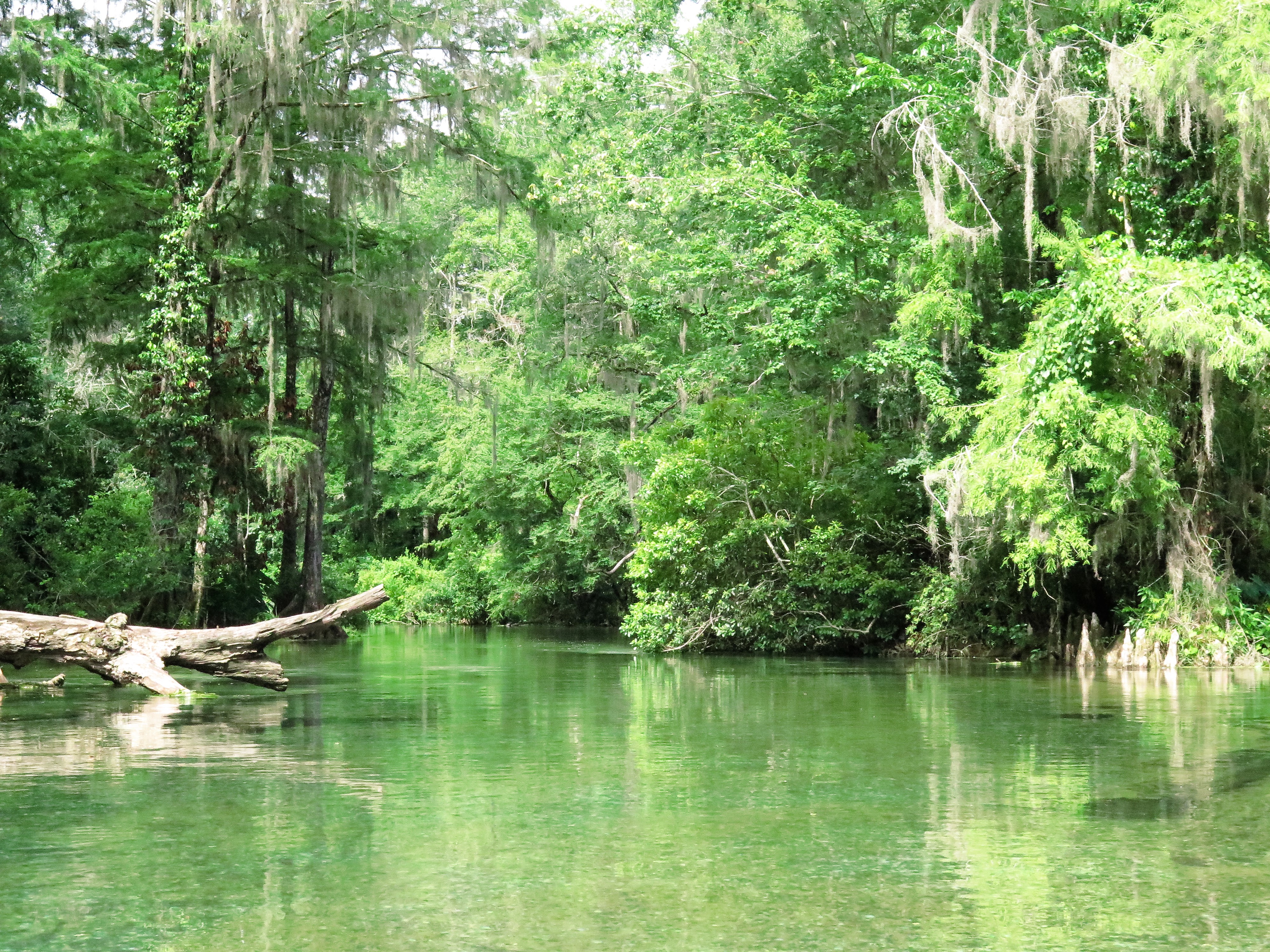
I paddled through the shallow, swampy waterway, around the cypress and swamp weeds, and emerged onto the Wacissa River. Long eel grasses waved in the cool, clear water beneath me. Around me, the river was wide and bordered with beautiful cypress, oak, maple, tupelo and pine trees…an “Old Florida” postcard.

Emerging Onto the Wacissa River

The Wacissa River begins close to where I put in—in the swamp with a couple small springs. However, the larger Big Blue Spring is considered the headwaters of the river. The river runs about 14 miles and ends as it flows into the Aucilla River by way of a man-made canal. About a dozen springs add to the flow of the Wacissa (Carter et al.).

I paddled south, towards Big Blue. An orchard of water plants, such as Pickerel weed, forced me to the middle of the river, away from the shade of the banks. The thought crossed my mind more than once that I should have saved this river for cooler weather! The water deepened, and below me, invasive hydrilla—like thick masses of dreadlocks—blocked much of the view of the sandy bottom.

As much as the water plants kept me from shade, they were also alive with sounds of screeching and squawking birds. I saw blue heron, common moorhen, and egrets. I paddled past the frolickers at the Wacissa County Park—splashing around, trying to keep cool on this very hot day. A couple young boys in a canoe had hooked a small gator—and neither the boys nor the gator seemed to want to give up the lure.

Big Blue Spring on the Wacissa River

I arrived at Big Blue Spring, delighted to find shade at last. I paddled over the Spring and peered into the clear water—beautiful shades of blue and green. However, the hydrilla growing in and around the Spring kept me from dipping. The ickiness of it all did not tempt me!

On my paddle back to the outfitter, I discovered that the river had many little nooks and crannies to explore which gave me a break from the sun. It really was a lovely river.

(Wacissa Canoe and Kayak. 290 Wacissa Springs Road, Monticello, FL 32344. (850) 997-5023)

Read Full Post »

Yippee for summer vacation! I headed to North Florida to paddle a few rivers. I had selected three: the Withlacoochee River North, the Wacissa, and Holmes. I stayed two nights in Live Oak, a very tiny town—and apparently “recently wet.” (a new term I learned from a bartender at what I believe was the only restaurant that sold liquor in Live Oak)

Lush Green on the Withlacoochee River North

Sunday morning, I headed to Withlacoochee River North, renting a kayak from Lucas at the Suwannee River Canoe Rental. Lucas dropped me at Blue Spring about 10:30 a.m.—not nearly early enough to beat the many families already splashing around in the clear cool water. Where else would one go on such a hot day? It was in the 90s, but it would feel in the 100s by mid-afternoon. Lucas would pick me up at the Suwannee River State Park—a 12-mile paddle from here (longer than usual for me!). It would take me about 6 hours—did I mention how hot it was?

There are two Withlacoochee Rivers in Florida. I have paddled the Withlacoochee River South—which originates in the Green Swamp—twice. I loved it. The Withlacoochee River North originates in Georgia. Its black waters flow about 70 miles in Georgia and then another 32 miles in Florida before the river finally flows into the Suwannee River. I would be paddling the final 12 miles of the river.

Lucas had told me that given the choice, most people chose the Suwannee over the Withlacoochee. He explained that the Suwannee has higher limestone banks and more sandy beaches for paddling picnics. I paddled the Suwannee a few years ago, and although beautiful, I had been surprised at the amount of trash along the river. The price of being popular, I suppose.

I paddled south and took in the “Withs” limestone banks, etched out by the movement of the water over the years which created beautiful designs and little caverns. The surrounding green forest of cypress, oak, maple and tupelo trees shaded the edges of the river, giving me a little break from the hot sun. Moss hung from the trees as if stretching to reach the river. Dark green ferns poured down the banks. This picturesque scene only needed a plantation to complete it. What a beautiful river!

Shoals on the Withlacoochee

Large fish jumped around me as I paddled. I laughed, thinking one would land in my kayak. Herons, hawks, turkey vultures, ducks and turtles braved the heat. I passed only an occasional paddler or flat-bottom boater along the way. I stopped by other springs, smaller than Blue: Pott, Tanner, and Suwanacoochee.

I heard the shoals before I saw them. Seriously, I thought I was approaching a sizeable water fall! But alas, most of the shoals were quite harmless. The final two shoals were much more fun, and the last one included a little white water as well! The small soaking I received helped to cool me down. Just after the last shoal, I spotted a deer on the west bank that had come to the river for a sip of cool, spring water.

As much as I loved paddling the Withlacoochee, after six and a half hours, I was happy to see the Suwannee River. Lucas was already there waiting for me.

(Outfitter: Suwannee River Canoe Rental. U.S. Highway 90, 4404 193rd Drive, live Oak, GL 32060. https://www.suwanneerivercanoerental.com/. (386) 364-4185. Lucas)

Read Full Post »

Spring term at the College had ended, and I desperately needed a get away! Don’t get me wrong; I love my job. However, the time had come to pull out my river guide books and my map and find a new paddle destination. I selected the Pithlachascotee River on the west coast.

A Quiet Day on the Cotee

It has taken me several years to get around to paddling the Pithlachascotee River—or the “Cotee” as those who know it well refer to it. I love the winding, twisting, secluded rivers—drop me in the swamp with no humans for miles around, and I’m happy. Much of the Cotee is an urban river, flowing through the town of New Port Richie—with the houses and busy boat traffic that accompany a wider, urban river. Thus, the delay.

So, I paddled the Cotee on a Friday morning, and I managed to avoid human contact almost completely. I put in at the James E. Grey Preserve–renting a kayak from Gill Dawg Marina (They dropped off and picked up!). I headed east, towards the river’s source, curious to see how far I could paddle before the fallen trees forced me to turn around.

The blackwaters of the Cotee flow about 25 miles from its source to the Gulf. The five-mile paddle from the Rowan Road Bridge to the Francis Avenue City Park is the official canoe trail. I planned to travel from the Preserve, east to Rowan Bridge and beyond, and then turn around and paddle west past my put in to the Francis Avenue City Park, and then, back to the Preserve.

I found the portion from my put-in at the Preserve to the bridge (east) and beyond, challenging—but lots of fun! I made the bridge in about 20 minutes and was able to paddle for another 30 minutes before I was forced to turn around. Along the way, the trees and brush dusted me with twigs and webs as I scrapped between fallen branches. I got stuck on submerged logs several times, and I was grateful to be in a sit-on-top kayak and able to hang my legs outside the kayak to shove myself off (a pretty picture, I know!).

A Heron on the Cotee

I saw little wildlife as I paddled—an occasional heron and a few turtles sunning themselves. Fish jumped around me in the murky waters. Heading west, the canopy disappeared, and the river widened and took on an estuarine quality, tall sea grasses lining the banks. Once I reached the Francis Avenue City Park, I made my turn and paddled back to the Preserve.

(Outfitter: Gill Dawg Marina. 5419 Treadway Drive, Port Richey, FL 34668. https://www.gilldawg.com/get-on-the-water/. (727) 842-1070)

Read Full Post »

« Newer Posts - Older Posts »